

The gig economy has opened countless doors for people looking to earn money on their own terms, and Remotasks jobs have emerged as a popular option for those willing to train artificial intelligence systems. This platform connects workers worldwide with companies that need human input to improve their AI models, offering flexible work that requires no specialized degree or extensive experience. Whether you’re searching for supplementary income or exploring best remote side hustles that fit your schedule, understanding how Remotasks operates can help you make an informed decision about whether this opportunity aligns with your financial goals.
What Are Remotasks Jobs
Remotasks is a micro-task platform owned by Scale AI, a company valued at billions of dollars that provides data annotation and AI training services to major technology companies. Workers on Remotasks complete small digital tasks that help train machine learning models, contributing to everything from autonomous vehicles to natural language processing systems.
The platform operates on a straightforward premise: artificial intelligence needs human intelligence to learn properly. While machines can process massive amounts of data quickly, they require human workers to label, categorize, and verify information so algorithms can recognize patterns and make accurate predictions.
Types of Tasks Available
Remotasks jobs span multiple categories, each requiring different skill levels and offering varying pay rates:
Image annotation: Drawing boxes around objects, identifying specific items in photos, or labeling different elements within images
LiDAR annotation: Working with 3D point cloud data used in autonomous vehicle development
Text transcription: Converting audio files to written text with proper formatting and accuracy
Data categorization: Sorting information into predefined categories based on specific criteria
Sentiment analysis: Evaluating text to determine emotional tone or intent
Audio transcription: Listening to recordings and creating accurate written versions
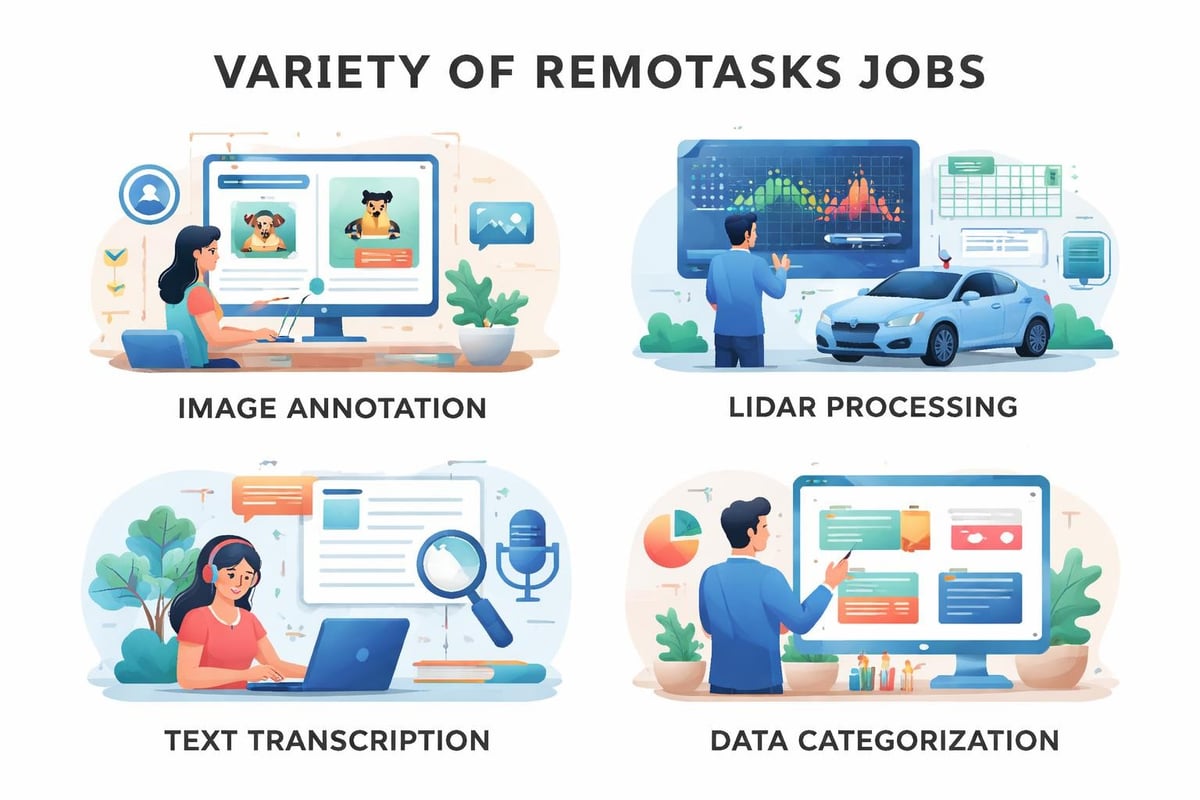
The complexity and requirements vary significantly across task types. Some assignments take seconds and pay a few cents, while more sophisticated projects like LiDAR annotation can pay several dollars per hour once you develop proficiency.
How to Get Started With Remotasks
Beginning your journey with Remotasks jobs requires completing several steps before you can access paid work. The onboarding process serves as both training and quality control, ensuring workers understand task requirements before affecting actual client projects.
Registration and Training Process
Create your account on the Remotasks website with basic personal information
Complete the placement test to assess your current skill level and task compatibility
Watch training videos specific to the task categories you want to pursue
Pass qualification exams that demonstrate competency in chosen task types
Start with practice tasks to build accuracy before accessing paid assignments
Graduate to paid tasks once you meet performance standards
The platform uses a bootcamp system where new workers learn through video tutorials and practice exercises. These training modules are unpaid, which frustrates some potential workers, but they’re essential for understanding quality standards and task-specific requirements.
Onboarding Phase | Time Investment | Payment Status | Purpose |
|---|---|---|---|
Account Setup | 5-10 minutes | Unpaid | Registration and verification |
Training Videos | 1-3 hours | Unpaid | Learning task fundamentals |
Qualification Tests | 30-90 minutes | Unpaid | Proving competency |
Practice Tasks | 1-2 hours | Unpaid | Building accuracy |
Paid Tasks | Ongoing | Paid | Actual work for clients |
Earning Potential and Payment Structure
Understanding the financial reality of Remotasks jobs requires examining both the payment system and the factors that influence your actual hourly rate. The platform doesn’t guarantee minimum wages, and earnings fluctuate based on task availability, your speed, accuracy, and the complexity of assignments you qualify for.
How Payments Work
Remotasks pays per completed task rather than hourly, with rates ranging from a few cents for simple categorization to several dollars for complex annotations. Workers receive payment through PayPal or Payoneer, with a minimum withdrawal threshold of $5 for most payment methods.
Factors affecting your earnings:
Task complexity and required skill level
Your accuracy rate and quality scores
Speed of task completion
Availability of tasks in your qualified categories
Time zone and when you work (task availability varies)
Your location (some tasks are region-specific)
Most workers report earning between $2 and $8 per hour when starting, with experienced taskers in specialized categories potentially earning $10-15 per hour. However, these rates include only active working time and don’t account for unpaid training, waiting for tasks, or work rejected due to quality issues.
Payment Timeline
Payments are processed weekly, typically on Wednesdays, for work completed the previous week. The actual transfer time depends on your chosen payment method, with PayPal transfers usually arriving within 24-48 hours after processing.
Task Quality and Account Standing
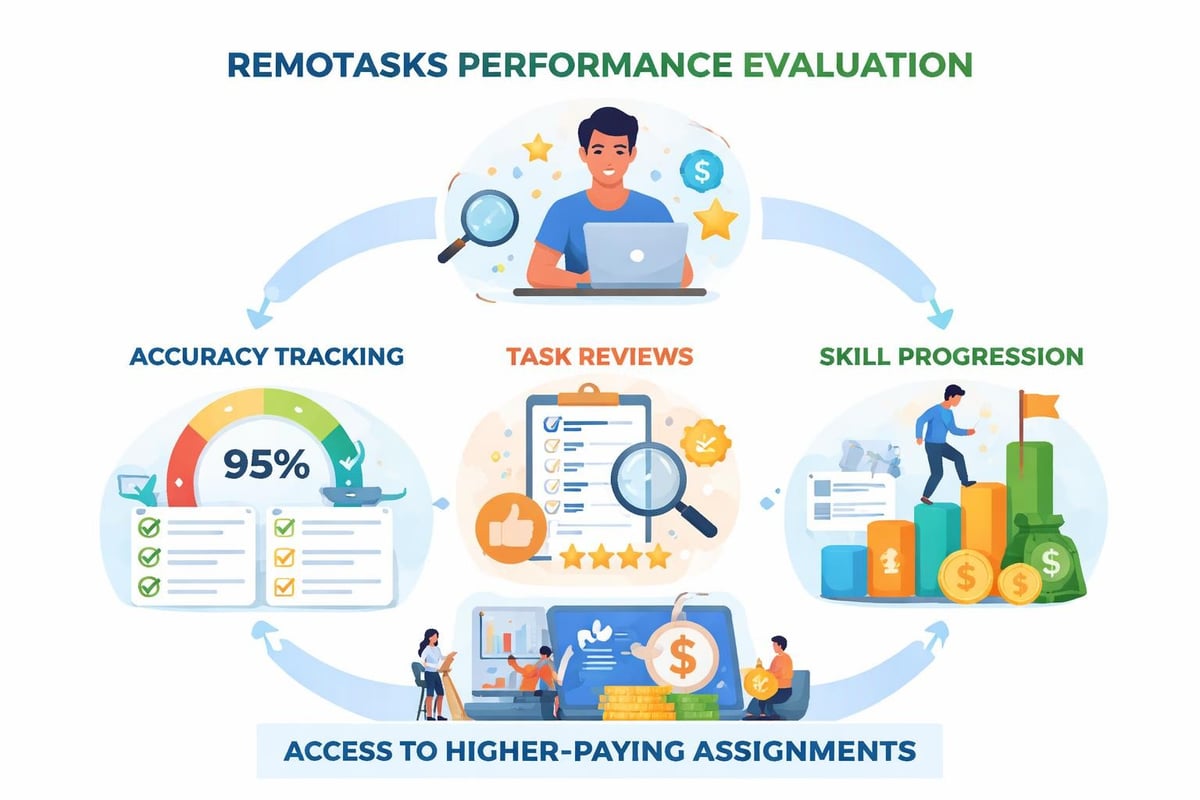
Success with Remotasks jobs depends heavily on maintaining high accuracy scores. The platform uses a quality control system that directly impacts your access to tasks and earning potential.
Quality Metrics That Matter
Your performance is tracked through several metrics that determine which tasks you can access:
Accuracy rate: Percentage of correctly completed tasks
Task completion speed: How quickly you finish assignments relative to other workers
Review outcomes: Results when your work is spot-checked by quality reviewers
Consistency: Maintaining standards across multiple tasks
Workers who consistently produce high-quality work gain access to better-paying tasks and may receive priority when new projects become available. Conversely, poor performance can result in restricted access, lower-paying assignments, or account suspension.
Pros and Cons of Remotasks Jobs
Before committing significant time to this platform, understanding both advantages and limitations helps set realistic expectations for what Remotasks jobs can deliver.
Advantages
Flexibility remains the primary benefit. You work when you want, for as long as you want, without schedules or minimum hour requirements. This makes Remotasks suitable for students, stay-at-home parents, or anyone seeking supplementary income around existing commitments.
No experience required for entry-level tasks
Work from anywhere with internet access
Learn valuable skills in AI and data annotation
No application or interview process
Low barrier to entry compared to traditional employment
Disadvantages
Income inconsistency poses the biggest challenge. Task availability fluctuates dramatically, sometimes leaving workers with nothing to do for hours or days. Reviews on Trustpilot and Sitejabber frequently mention this unpredictability as a major frustration.
Unpaid training time required before earning
No guaranteed minimum wage or hourly rate
Task availability varies significantly by location and time
Quality standards can be strict and unclear
Support responsiveness issues reported by some users
Payment rates may not justify time investment for everyone
Aspect | Positive | Negative |
|---|---|---|
Schedule | Complete flexibility | No guaranteed hours |
Training | Free skill development | Unpaid learning period |
Payment | Weekly payouts, low minimum | Below minimum wage for many |
Tasks | Variety of options | Inconsistent availability |
Support | Email assistance available | Slow response times reported |
Is Remotasks Legitimate
Given the proliferation of online scams, questioning whether Remotasks jobs are genuine opportunities makes sense. The platform is owned by Scale AI, a well-funded company that provides services to major corporations including General Motors, Samsung, and Microsoft.
Verification and Reviews
Scale AI has raised over $600 million in funding from reputable venture capital firms, giving it credibility as a real business with substantial backing. The company needs human workers to fulfill contracts with enterprise clients, creating genuine demand for the micro-tasks offered on Remotasks.
However, legitimacy doesn’t necessarily mean profitability for workers. According to a Time article on data annotation jobs, while these positions are real and payments are made, many workers earn less than minimum wage when accounting for all time invested, including training and waiting for tasks.
The Better Business Bureau profile shows mixed reviews, with some workers praising the flexibility while others complain about payment issues and task availability. Looking at BBB complaints reveals concerns about account suspensions and payment disputes, though the company does respond to most grievances.
Red Flags to Consider
While Remotasks isn’t a scam, certain aspects warrant caution:
Payment rates are low compared to minimum wage in developed countries
Task availability can disappear without warning
Quality standards sometimes change without clear communication
Account suspensions can occur with limited explanation
Some workers report difficulty withdrawing earnings
Maximizing Your Success on Remotasks
If you decide that Remotasks jobs align with your income goals and schedule, implementing strategic approaches can improve your earning potential and overall experience.
Strategies for Better Earnings
Focus on specialization rather than dabbling. Workers who master one or two complex task types typically earn more than those attempting every available category. LiDAR annotation and specialized image labeling generally pay better than basic transcription or simple categorization.
Track your actual hourly rate by recording all time spent, including training, task completion, and waiting periods. This honest assessment reveals whether the platform meets your financial needs or if you should explore alternative side hustles to make money.
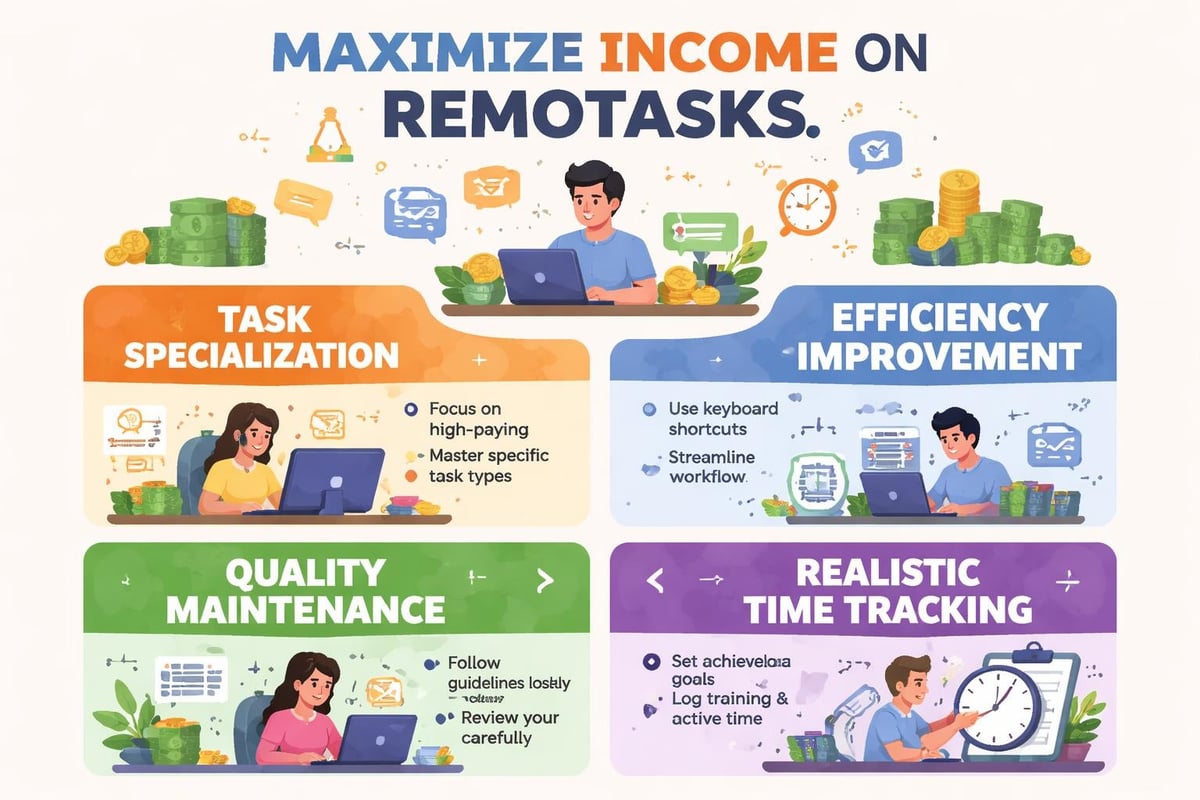
Complete training thoroughly to avoid costly mistakes later
Work during peak hours when tasks are most available
Maintain high accuracy to access better-paying assignments
Use keyboard shortcuts and efficiency tools where permitted
Join community forums to learn from experienced taskers
Diversify income sources rather than relying solely on Remotasks
Time Management Tips
Because task availability varies, treating Remotasks as your primary income source creates financial risk. Instead, position it as supplementary income that fills gaps in your schedule or complements other freelance work.
Set specific time blocks for checking task availability rather than constantly monitoring the platform. This prevents wasted time refreshing for tasks while allowing you to capture opportunities when they appear. Consider pairing Remotasks with other micro-task platforms to maintain steadier income flow.
Alternatives and Comparisons
Remotasks exists within a broader ecosystem of micro-task and data annotation platforms. Understanding how it compares to alternatives helps you make informed decisions about where to invest your time.
Similar Platforms Worth Considering
Several competitors offer similar work with different payment structures, task types, and requirements:
Amazon MTurk: More task variety but often lower pay rates
Appen: Higher barrier to entry but more stable project-based work
Lionbridge: Requires specific qualifications but offers longer-term contracts
Clickworker: Similar micro-tasks with different payment methods
DataAnnotation.tech: Specialized in AI training with competitive rates
Each platform has unique advantages and drawbacks. Diversifying across multiple services reduces income volatility and provides backup options when one platform experiences slow periods. This approach mirrors pricing freelance services by not relying on single income streams.
Who Should Consider Remotasks Jobs
Not everyone will find Remotasks jobs suitable for their situation, skills, or financial needs. Identifying whether this opportunity matches your circumstances helps avoid wasted time and frustration.
Ideal Candidates
Students seeking flexible income often benefit most from Remotasks. The ability to work between classes, during breaks, or late at night accommodates academic schedules better than traditional employment. The low barrier to entry means no extensive job search or interview process.
International workers in countries with lower cost of living may find the pay rates more acceptable relative to local wages. What seems like low payment in the United States or Western Europe might represent reasonable compensation in regions where the dollar stretches further.
People learning about AI and machine learning gain hands-on experience with how training data shapes artificial intelligence systems. This knowledge can support career transitions into tech fields or provide context for understanding emerging technologies.
Who Should Look Elsewhere
Workers needing consistent, predictable income should explore more stable opportunities. The variability in task availability makes budgeting difficult and creates stress when bills need paying but tasks aren’t available.
Those expecting to earn traditional wages for their time will likely feel disappointed. The pay structure rewards speed and efficiency but rarely matches local minimum wage when honestly calculating all time invested, including training and idle periods.
Managing Expectations and Building Skills
Approaching Remotasks jobs with realistic expectations prevents disappointment while allowing you to extract maximum value from the experience. Understanding this as skill development rather than primary employment reframes the value proposition.
What to Realistically Expect
Most new workers should anticipate earning $3-5 per hour initially, with potential increases to $8-12 per hour after developing expertise in specific task categories. This calculation should include all time spent on the platform, not just actively completed tasks.
Task availability fluctuates based on client demand, your location, time zones, and competition from other workers. Some days offer abundant work while others provide nothing, making this unsuitable as sole income but potentially valuable as supplementary earnings.
Skills You’ll Develop
Even if financial returns prove modest, Remotasks jobs build transferable capabilities:
Attention to detail through precise annotation and categorization work
Quality control understanding as you learn to meet specific standards
Basic data literacy working with various data types and formats
Time management maximizing efficiency within piece-rate payment structures
Technical familiarity with annotation tools and digital platforms
These competencies support transitions into better-paying remote work, freelance opportunities, or positions in data science and AI development. Consider Remotasks as paid training rather than a career endpoint.
Remotasks jobs offer genuine opportunities for flexible, remote income, though payment rates and task availability create limitations that prevent this from serving as primary employment for most workers. The platform works best as supplementary income that builds AI-related skills while accommodating irregular schedules. If you’re exploring diverse ways to build online income beyond micro-tasks, Side Hustle Hackers provides comprehensive resources, honest reviews, and practical guidance for finding legitimate opportunities that match your skills, schedule, and financial goals.


