
Starting a pressure washing business represents one of the most accessible entry points into entrepreneurship for anyone seeking flexible income opportunities. With relatively low startup costs compared to other service businesses, this venture offers immediate cash flow potential while allowing you to work on your own schedule. The demand for exterior cleaning services continues to grow as homeowners and businesses prioritize property maintenance, creating a sustainable market for newcomers willing to deliver quality results and exceptional customer service.
Understanding the Pressure Washing Business Model
The pressure washing business operates on a straightforward service-for-payment model that appeals to both residential and commercial clients. Your primary revenue comes from cleaning exterior surfaces like driveways, decks, siding, parking lots, and commercial buildings.
What makes this business attractive:
- Low barrier to entry with minimal certifications required
- Flexible scheduling that fits around other commitments
- Scalable from solo operation to full crew
- Repeat customer potential through seasonal contracts
- Cash-based transactions that improve cash flow
The business model allows you to start small and expand strategically. Many successful operators begin with residential driveways and fences before moving into higher-paying commercial contracts. This progression lets you build skills, reputation, and capital simultaneously.
Revenue Streams and Income Potential
A pressure washing business generates income through multiple service categories. Understanding these revenue streams helps you diversify offerings and maximize earning potential.
| Service Type | Average Price Range | Time Required | Profit Margin |
|---|---|---|---|
| Residential Driveway | $150-$300 | 2-3 hours | 60-75% |
| House Washing | $300-$600 | 3-5 hours | 65-70% |
| Deck Cleaning | $200-$400 | 2-4 hours | 60-70% |
| Commercial Building | $500-$2,000+ | 4-8 hours | 50-65% |
| Fleet Washing | $50-$150 per vehicle | 30-60 min | 55-65% |
The income potential varies significantly based on your market, efficiency, and business strategy. Solo operators commonly earn $50,000-$80,000 annually working part-time, while full-time businesses with crews can exceed $150,000 in revenue. Those treating it as a side hustle for beginners can realistically generate $1,000-$3,000 monthly working weekends.
Essential Equipment and Startup Costs
Building your equipment arsenal represents the most significant initial investment. The good news is you can start with basic gear and upgrade as revenue grows.
Core Equipment Requirements
Your foundational equipment list includes:
- Pressure washer unit: Gas-powered models (3,000-4,000 PSI) run $400-$1,200
- Surface cleaner attachment: Essential for even cleaning, costs $150-$400
- Nozzles and tips: Various spray patterns, $30-$80 total
- Hoses: 50-100 feet of high-pressure hose, $80-$200
- Chemicals and detergents: Specialty cleaners for different surfaces, $100-$300 initially
- Safety equipment: Goggles, gloves, boots, hearing protection, $100-$200
- Transportation: Truck or trailer to haul equipment
Total startup costs typically range from $2,000 to $5,000 for a basic setup, making this one of the more affordable gigs to start. As you grow, you might invest in hot water units ($3,000-$8,000) that tackle grease and stubborn stains more effectively.
Budget-friendly startup tips:
- Purchase quality used equipment from retiring operators
- Rent specialized equipment for occasional jobs
- Start with residential services requiring less powerful equipment
- Finance equipment through business credit once established
When selecting equipment, prioritize reliability over features. A dependable 3,000 PSI unit beats an unreliable 4,000 PSI model every time. GoDaddy’s guide to starting a pressure washing business emphasizes the importance of creating a detailed equipment budget before making purchases.
Legal Requirements and Business Setup
Establishing your pressure washing business legally protects your assets and builds credibility with clients. The specific requirements vary by location, but certain fundamentals apply across most jurisdictions.
Licensing and Permits
Most states don’t require specialized licenses for basic pressure washing, though some municipalities mandate business licenses. WorkZen’s comprehensive startup guide outlines the typical licensing requirements across different regions.
Registration checklist:
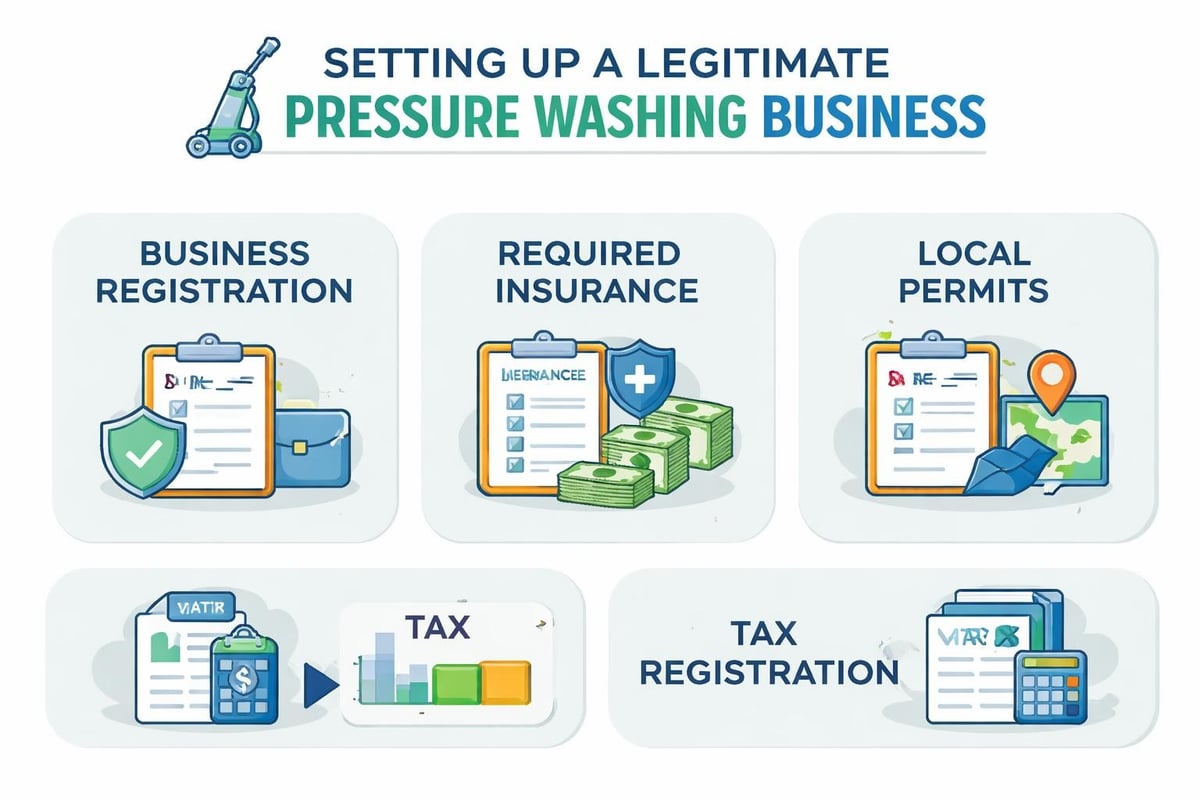
- Register your business name with your state
- Obtain an Employer Identification Number (EIN) from the IRS
- Apply for local business licenses
- Register for state sales tax collection
- Check environmental regulations for wastewater disposal
- Verify if you need contractor licensing for certain surfaces
Insurance Coverage
Insurance represents a non-negotiable expense for pressure washing operations. The high-pressure equipment and chemical usage create liability exposure that could devastate your finances without proper coverage.
MoneyGeek’s insurance guide details the essential policies:
- General liability insurance: Covers property damage and bodily injury ($500-$1,500 annually)
- Equipment insurance: Protects your gear from theft or damage ($200-$600 annually)
- Commercial auto insurance: Required if using vehicles for business ($1,000-$2,500 annually)
- Pollution liability: Covers environmental damage from chemical runoff ($400-$1,000 annually)
Many clients, especially commercial accounts, require proof of insurance before contracting services. Budget $2,000-$4,000 annually for comprehensive coverage when starting out.
Pricing Strategies That Win Jobs
Determining your pricing strategy involves balancing competitive rates with profitable margins. Underpricing damages the industry and your sustainability, while overpricing limits customer acquisition.
Pricing Models and Calculations
Most pressure washing businesses use one of three pricing approaches:
| Pricing Method | Best For | Calculation | Pros/Cons |
|---|---|---|---|
| Per Square Foot | Large flat surfaces | $0.08-$0.40 per sq ft | Accurate, scalable / Time-consuming to measure |
| Hourly Rate | Complex or unknown jobs | $60-$150 per hour | Simple, fair / Less predictable income |
| Flat Rate | Standard services | Set price per job type | Easy to quote / May underestimate difficulty |
The per-square-foot model works best for driveways, parking lots, and building exteriors. Calculate your costs (equipment wear, chemicals, fuel, labor) and add your desired profit margin. If you’re new to pricing freelance services, start by researching local competitors and positioning slightly below market rate until you build reviews.
Factors affecting your pricing:
- Surface type and condition (concrete vs. wood, new vs. heavily stained)
- Geographic location and local cost of living
- Travel distance from your base
- Specialized equipment or chemicals required
- Accessibility and obstacles
Always include a minimum service charge ($100-$150) to ensure smaller jobs remain profitable after accounting for travel time and equipment setup.
Marketing Your Pressure Washing Business
Effective marketing transforms a struggling side hustle into a thriving enterprise. The pressure washing business benefits from both digital and traditional marketing approaches.
Digital Marketing Essentials
Your online presence forms the foundation of modern customer acquisition. Topline Pro’s marketing guide emphasizes the importance of a multi-channel digital strategy.
Priority digital channels:
- Google Business Profile: Claim and optimize your listing with photos, hours, and service areas
- Facebook and Instagram: Share before/after photos that demonstrate transformation
- Local SEO: Target searches like “pressure washing near me” with location-specific content
- Review platforms: Actively request reviews on Google, Yelp, and Facebook
- Email marketing: Build a list for seasonal promotions and maintenance reminders
Before/after photos generate the most engagement in this visual industry. Document every significant transformation and share across all platforms. Video content showing the cleaning process builds trust and educates potential customers about your value.
Traditional Marketing That Works
Don’t overlook offline marketing tactics that still deliver results:
- Door hangers and flyers: Target neighborhoods after completing a job
- Vehicle wraps: Turn your truck into a mobile billboard
- Yard signs: Place at job sites with permission
- Local partnerships: Connect with real estate agents, property managers, and contractors
- Community involvement: Sponsor local events or offer discounted services to nonprofits
Many successful operators report that 40-60% of new business comes from referrals. Implement a referral incentive program offering $25-$50 discounts for every new customer referral. This transforms satisfied clients into active promoters of your business.
Similar to strategies for finding freelance clients, networking within your community creates sustainable customer pipelines that don’t rely solely on paid advertising.
Operational Excellence and Safety
Running a professional pressure washing business requires attention to operational details that separate amateurs from established professionals.
Safety Protocols and PPE
Pressure washing involves significant safety hazards. Water pressure exceeding 2,000 PSI can cause serious injuries, and chemical exposure presents additional risks. Oregon’s PPE standards outline industry best practices.
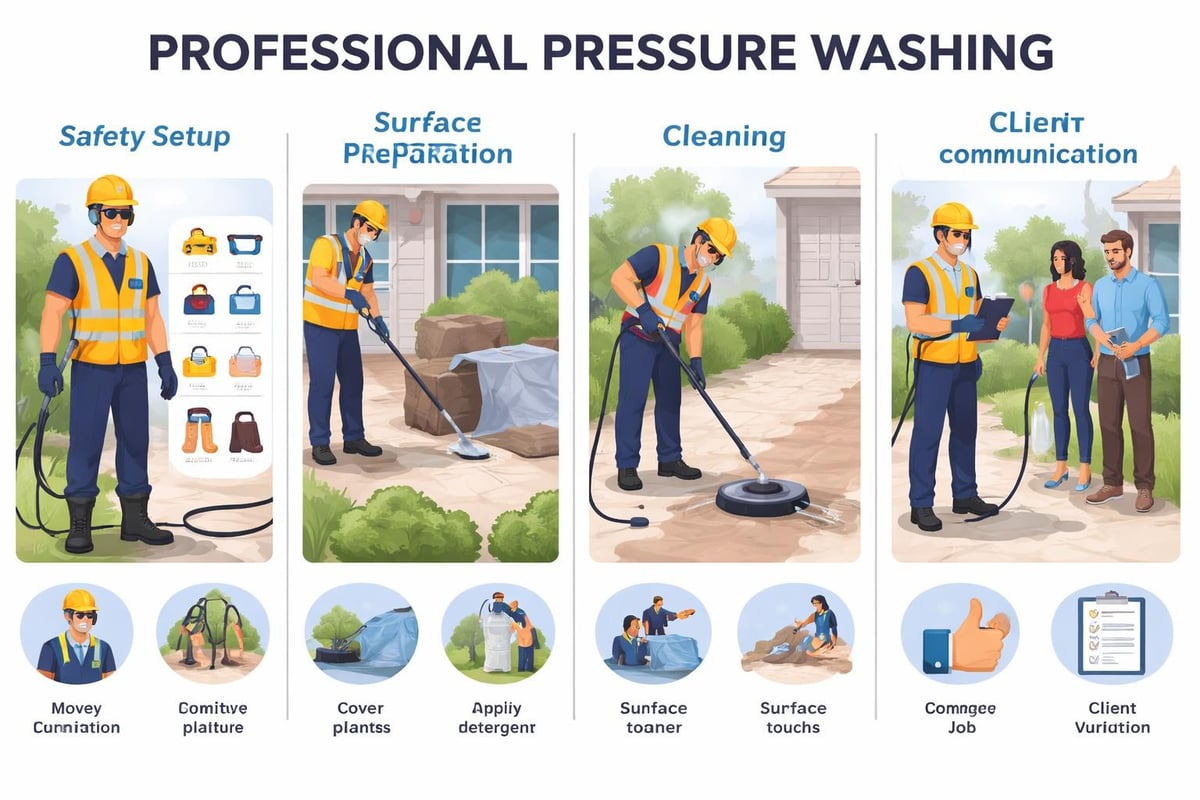
Required personal protective equipment:
- Safety glasses or face shields to protect from debris
- Chemical-resistant gloves for handling detergents
- Waterproof boots with non-slip soles
- Hearing protection when operating gas-powered units
- Respiratory protection when using certain chemicals
- Long pants and long-sleeve shirts to prevent skin exposure
Never underestimate the kickback from high-pressure equipment. Maintain proper stance, use two hands on the wand, and never point the spray at yourself or others. Professional operators also carry first aid kits and know how to respond to pressure injection injuries.
Environmental Compliance
Water runoff and chemical disposal face increasing regulation. Many municipalities prohibit untreated wastewater from entering storm drains. Check local requirements, as violations carry substantial fines.
Environmental best practices:
- Use biodegradable, phosphate-free detergents when possible
- Implement water reclamation systems for commercial jobs
- Block storm drains and collect wastewater where required
- Minimize water usage through efficient techniques
- Dispose of collected wastewater according to local regulations
Some commercial contracts require specific environmental certifications or procedures. The City of Austin’s commercial power washing requirements demonstrate the detailed compliance expectations in regulated markets.
Growing Beyond Solo Operations
As your pressure washing business gains traction, you’ll face decisions about scaling operations. Growth requires strategic planning to maintain profitability while expanding capacity.
Hiring and Training Employees
Adding employees multiplies your earning potential but introduces new challenges. Your first hire typically focuses on helping with labor-intensive jobs and allowing you to book simultaneous appointments.
Employee hiring considerations:
- Start with part-time help during peak seasons
- Develop written procedures and safety protocols
- Invest in proper training before sending them to jobs alone
- Carry workers’ compensation insurance
- Consider independent contractors initially to test demand
Training should cover equipment operation, surface-specific techniques, chemical handling, customer service, and safety procedures. Many operators require 2-4 weeks of shadowing before allowing solo work.
Expanding Service Offerings
Diversification stabilizes income and increases customer lifetime value. Natural expansion services include:
- Soft washing for delicate surfaces like roofs and stucco
- Gutter cleaning paired with exterior house washing
- Window cleaning as an add-on service
- Sealing and staining after deck cleaning
- Holiday lighting installation using existing customer relationships
Each additional service requires new equipment, training, and marketing, but leverages your existing customer base. Survey your clients about desired services before investing in new capabilities.
Building Systems for Sustainability
Systematic approaches separate sustainable businesses from exhausting hustle. Implementing processes reduces stress and improves consistency.
Customer Management and Scheduling
Invest in software that manages appointments, sends reminders, and tracks customer history. Solutions like Jobber, Housecall Pro, or ServiceTitan range from $50-$200 monthly but save hours of administrative work.
Key systems to implement:
- Online booking that reduces phone tag
- Automated appointment reminders to decrease no-shows
- Digital invoicing with payment processing
- Customer relationship management for follow-up
- Route optimization to minimize drive time
Track your metrics religiously. Know your average job value, cost per acquisition, customer retention rate, and profit margin by service type. This data drives intelligent business decisions.
Seasonal Planning and Cash Flow
Pressure washing experiences seasonal fluctuations in most climates. Northern regions see 60-80% of annual revenue from April through October. Planning for this reality prevents financial stress.
Seasonal strategies:
- Build cash reserves during peak months for slower periods
- Offer winter services like snow removal or holiday decorating
- Focus on commercial clients who need year-round service
- Use slow months for equipment maintenance and marketing
- Consider passive income streams to supplement winter income
Many operators combine pressure washing with complementary seasonal businesses. Lawn care, landscaping, or Christmas light installation create year-round revenue using similar customer bases and equipment.
Customer Service That Drives Referrals
Exceptional service creates the foundation for sustainable growth through referrals and repeat business. In a competitive market, your reputation determines long-term success.
Communication Excellence
Professional communication starts with the first contact and continues through follow-up. Respond to inquiries within 24 hours, preferably within 2-4 hours. Provide detailed quotes explaining exactly what’s included.
Communication best practices:
- Send confirmation texts or emails 24 hours before appointments
- Arrive on time or notify customers immediately if delayed
- Explain the process and set realistic expectations
- Document the work with photos for records
- Follow up within 48 hours to ensure satisfaction
Small touches distinguish your service. Protecting landscaping with tarps, cleaning up thoroughly, and leaving a thank-you note with your business card creates memorable experiences that generate word-of-mouth referrals.
Managing Difficult Situations
Every service business encounters challenging customers or unexpected problems. Your response determines whether issues become negative reviews or opportunities to demonstrate professionalism.
When problems arise, respond quickly, take responsibility without making excuses, and offer solutions that exceed expectations. A customer who sees you fix a mistake often becomes more loyal than one who never experienced an issue.
Problem resolution framework:
- Listen completely without interrupting
- Acknowledge their frustration
- Propose 2-3 solutions and let them choose
- Follow through immediately
- Follow up to confirm satisfaction
Document all customer interactions, especially problem resolutions. This protects you from false claims and provides learning opportunities to improve processes.
Leveraging Technology and Tools
Modern technology dramatically improves efficiency in the pressure washing business. The right tools streamline operations and enhance professionalism.
Must-Have Business Applications
Beyond customer management software, several tools optimize operations:
- Stripe or Square: Process payments on-site through mobile devices
- QuickBooks or FreshBooks: Manage finances and simplify tax preparation
- Google Calendar: Coordinate schedules and block service areas
- Waze or Google Maps: Optimize routes and track mileage for taxes
- Canva: Create professional marketing materials affordably
Many AI tools now assist with customer communication, quote generation, and social media content creation. These technologies level the playing field between solo operators and established companies.
Financial Management Basics
Separate personal and business finances immediately. Open a dedicated business checking account and use accounting software to track every transaction. This simplification saves headaches during tax season and provides clarity about actual profitability.
Financial tracking essentials:
- Record all income and categorize expenses
- Set aside 25-30% of revenue for taxes
- Track equipment depreciation
- Monitor profit margins by service type
- Calculate true hourly earnings including all costs
Understanding your numbers reveals which services generate the best returns and where to focus growth efforts. Many operators discover their most time-consuming services are least profitable when accounting for all costs.
Building a Pressure Washing Business Timeline
Setting realistic expectations about business development prevents discouragement. Most successful operators follow a similar growth trajectory.
Year 1: Foundation and Learning
- Months 1-3: Equipment purchase, licensing, initial marketing, first 10-20 customers
- Months 4-6: Refining techniques, building reviews, establishing pricing
- Months 7-9: Developing repeat customers, expanding service area
- Months 10-12: Evaluating performance, planning for year two
Year 2: Growth and Optimization
- Systematize operations and improve efficiency
- Expand marketing to more profitable services
- Consider hiring part-time help
- Develop commercial client relationships
- Target $50,000-$75,000 in revenue
Year 3: Scaling and Decisions
- Evaluate full-time transition versus maintaining as side income
- Hire employees if pursuing growth
- Invest in advanced equipment
- Establish maintenance contracts for predictable revenue
- Potential for $100,000+ revenue with dedicated effort
This timeline assumes part-time operation while maintaining other income sources. Full-time commitment accelerates progress significantly. Like other online jobs and flexible income opportunities, success correlates directly with consistent effort and strategic planning.
A pressure washing business offers one of the most practical paths to flexible income, combining low startup costs with strong demand and scalability. The fundamentals covered here provide a complete roadmap from initial equipment purchases through systematic growth and customer acquisition. If you’re ready to explore this opportunity alongside other proven income strategies, Side Hustle Hackers delivers the honest reviews, practical tools, and community support you need to build sustainable income on your own terms.


